



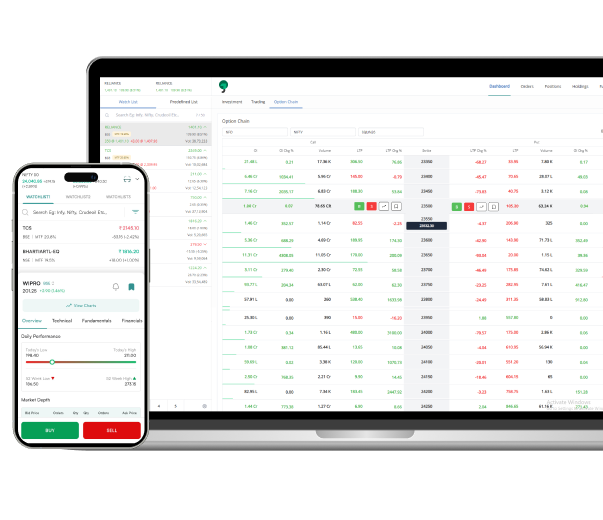
Benefits of Futures Trading
Benefits of Futures Trading
Unlock advanced futures trading benefits for enhanced leverage, risk management, and strategic market opportunities.

Leverage
Hold large positions with relatively little capital and magnify potential gains with effective risk management to minimize risks.

High Liquidity
With easy entry and exit for investors, large volumes of trading make bid-ask spreads low, transactions cheap and also reduces slippage.

Hedging Opportunities
Hedge against changes in the prices of commodities, currencies, and indices to stabilize cash flows and cut down uncertainty.

Diversification
Get exposure to multiple asset classes such as commodities, stocks, currencies, and diversify portfolio risk by hedging investments.

Cost Efficiency
Lower margins and competitive price structures make execution effective and lower transaction charges to increase profitability.

Price Discovery
Transparent price determination through continuous trading by accurately capturing real-time supply and demand conditions.

Speculative Gains
High volatility in futures markets provides skilled participants with profitable opportunities, enhancing potential profit.

Standardization
Standardization with regard to quantity, quality, and delivery dates maximizes market efficiency and minimizes counterparty risks.
F&O Features at Jainam


Basket Order:Place multiple orders together in a single basket for faster and more efficient trade execution.

Collateral Benefit: Use eligible securities from your holdings as collateral to access margin benefits, subject to applicable terms and conditions.

Multileg Strategies: Execute multiple legs of an options strategy together, making complex strategies easier to manage.

Trading Calls: Get research-based trading insights and real-time market updates to support informed trading decisions.

Sophisticated Tools: Access tools such as Margin Pledge, Order Slicing, and Option Greeks for efficient trading and options analysis.

Margin Calculator: Calculate the estimated margin required for your trades and plan your capital before placing an order.


About Futures Trading
What Is Futures Trading?
Futures trading is the buying or selling of standardized contracts that allow traders to buy or sell an underlying asset at a predetermined price on a specified future date. Futures contracts are traded on recognized exchanges and are available across various asset classes, including stock futures, index futures, commodity futures, and currency futures.
For example, a trader may buy a gold futures contract at a specified price with an agreed expiry date. If the price of gold rises before the trader closes the position, the trader may earn a profit. If the price falls, the trader may incur a loss.
In India, futures trading is commonly used for speculation, hedging, price discovery, and portfolio diversification.
Why Do Traders Use Futures?
One of the key features of futures trading is leverage. Traders can take a larger market position by depositing a margin amount instead of paying the full value of the underlying asset upfront. However, leverage can increase both potential profits and potential losses.
Futures can also be used to manage market risk. For example, an investor holding stocks may use index futures to hedge against a potential decline in the broader market.
Futures markets are generally standardized and exchange-traded, which can support transparent pricing and efficient trade execution.
Advantages of Futures Trading
1. Leverage
Futures trading allows traders to take positions by depositing a margin rather than paying the full contract value upfront. This can increase the potential return on the capital deployed, but it also increases the risk of losses.
2. Hedging and Risk Management
Futures can help investors and businesses manage the impact of price fluctuations.
For example, an investor with a portfolio of stocks may sell Nifty 50 futures if they expect the broader market to decline. If the market falls, gains from the futures position may help offset some losses in the portfolio.
3. Diversification
Futures contracts are available across multiple asset classes, including equity indices, stocks, commodities, and currencies. This gives traders different opportunities to participate in various markets.
4. Price Discovery
Futures markets bring together buyers and sellers, helping determine market prices based on demand and supply. This process is known as price discovery.
5. Standardized Contracts
Exchange-traded futures contracts are standardized in terms of contract specifications, quantity, expiry, and other conditions. Standardization helps make futures contracts easier to trade and compare.
Futures Trading Example
Suppose the Nifty 50 futures price is ₹22,000 and a trader expects the market to decline.
The trader sells Nifty 50 futures at ₹22,000.
Case 1: Nifty Futures Fall to ₹21,500
If the trader closes the futures position at ₹21,500, the price difference is ₹500 per unit. The trader may earn a profit of ₹500 per unit, before applicable charges and other adjustments.
Case 2: Nifty Futures Rise to ₹22,500
If the futures price rises to ₹22,500, the trader may incur a loss of ₹500 per unit when the position is closed.
The actual profit or loss depends on the contract size, entry and exit prices, margin requirements, brokerage, taxes, and other applicable charges.
Risks of Futures Trading
While futures trading can provide opportunities to manage risk and participate in market movements, it also involves significant risks.
Because futures use margin and leverage, a relatively small movement in the underlying asset can result in a comparatively large profit or loss on the capital deployed. Traders should understand the contract specifications, margin requirements, expiry, and associated costs before trading.
Futures trading is not suitable for every investor. Proper risk management and an understanding of market conditions are important when trading futures contracts.
Futures Trading in India
In India, futures contracts are available across segments such as equity, index, commodity, and currency derivatives through recognized exchanges. Traders should check the latest contract specifications, expiry dates, margin requirements, and applicable charges before taking a position.
Key Takeaways
- Futures trading involves buying or selling standardized futures contracts.
- Futures can be used for trading, hedging, diversification, and price discovery.Online Stock Trading & Stock Broking in India – Jainam
- Leverage allows traders to take larger positions with a margin amount but also increases risk.
- Futures are available across multiple asset classes.
- Understanding margin, contract size, expiry, and risk is essential before trading futures.
Redefine your growth, explore HOGrowth
Learn More

You may also like
View All
9 Hidden Things to Know About Futures Trading
December 17, 2024
16 min read
What is Futures Trading? A Comprehensive Guide
November 28, 2024
14 min read
Top 5 Futures Trading Strategies to Know in 2024 – 2025
December 17, 2024
16 min read
Frequently Asked Questions
What are Futures?
Futures are standardized contracts to buy or sell an asset at a fixed price at an agreed future date.
Which are the Long-Dated Futures?
Long-dated futures have longer expiries than the usual monthly contracts, like three-month or annual contracts.
What are the fees involved in Futures trading?
Fees include brokerage, exchange charges, SEBI fees, GST, and Securities Transaction Tax (STT).
What are the advantages of Futures trading?
Futures offer leverage, liquidity, hedging, diversification, cost efficiency, and price discovery.
How are Futures Contracts settled?
Contracts are settled via physical delivery or cash settlement at market prices.
What is the difference between Futures and Options?
Futures are compulsorily executed at expiry, while options give the options buyer the right but not the obligation to execute the trade on expiry.
What are the various types of Futures Contracts?
There are stock futures, index futures, commodity futures, currency futures, and interest rate futures included in futures contracts.
Which exchanges trade Futures in India?
In India, Futures trading is available on NSE, BSE, MCX, NCDEX, and India INX, covering equities, indices, commodities, and currencies. These exchanges offer a regulated platform for traders to hedge risks and speculate on price movements.
What is Hedging in Futures Trading?
Hedging uses futures to offset potential losses from price fluctuations in assets.
Explore our feature-rich web trading platform
Get the link to download the App