



How to Convert Physical Shares to Demat? Steps, Eligibility, and Risks



Introduction
If you want to invest in the stock market, a demat account is a must. SEBI (Securities and Exchange Board of India) has made it mandatory for everyone that without a Demat account, you can’t buy or sell securities, trade, or invest in ETFs. To convert physical shares into demat form, you must follow some process.
In the digital era, where convenience and efficiency reign supreme, the process of converting physical shares to demat accounts in India has become increasingly popular. This article will guide you through the dematerialisation process, explaining the steps involved, eligibility criteria, benefits, and more.
What are Physical Shares?
Physical shares, also known as physical stock certificates, are paper documents that represent ownership of a certain number of shares in a company. These certificates were the primary way of recording stock ownership before the advent of electronic or dematerialized shares.
Transition to Dematerialized Shares:
The advent of electronic or dematerialized shares (demat shares) has largely replaced physical shares. Dematerialization refers to converting physical share certificates into an electronic form held in a demat account. This transition offers several advantages:
- Safety: Electronic shares are stored in a secure digital format, reducing the risk of loss, theft, or damage.
- Efficiency: Simplifies and speeds up the process of trading and transferring shares.
- Convenience: Buying, selling, and transferring shares electronically is faster and more efficient, with transactions typically settled within two working days.
- Accessibility: Shareholders can easily access and manage their holdings online through their demat account, making it easier to track investments.
- Reduced Costs: The costs associated with printing, storing, and handling physical certificates are eliminated.
- Elimination of Odd Lots: Facilitates trading in any quantity, removing the issue of odd lots.
What is Dematerialisation?
Dematerialization (or Demat) is the process of converting physical share certificates into electronic form, held in a demat account. This shift from physical to electronic form aims to enhance the efficiency, security, and convenience of handling shares and other securities.
Digital securities are stored at CDSL i.e., Central Depository Services India Limited, and NSDL i.e., National Securities Depository Limited, which are registered with the SEBI. To convert physical shares into digital form, investors need to open a Demat account, which serves as a digital wallet for investments.
A Depository Participant (DP) acts as a middleman in the conversion process. The depository verifies and cancels the physical certificates, and then credits the digital shares to the Demat account. Investors must provide accurate identity, residence address, and financial documents, and complete forms to ensure the physical certificates are in good condition. Dematerialization makes investment management simpler and more secure by removing the need for paper certificates.
How to Convert Physical Shares to Demat?
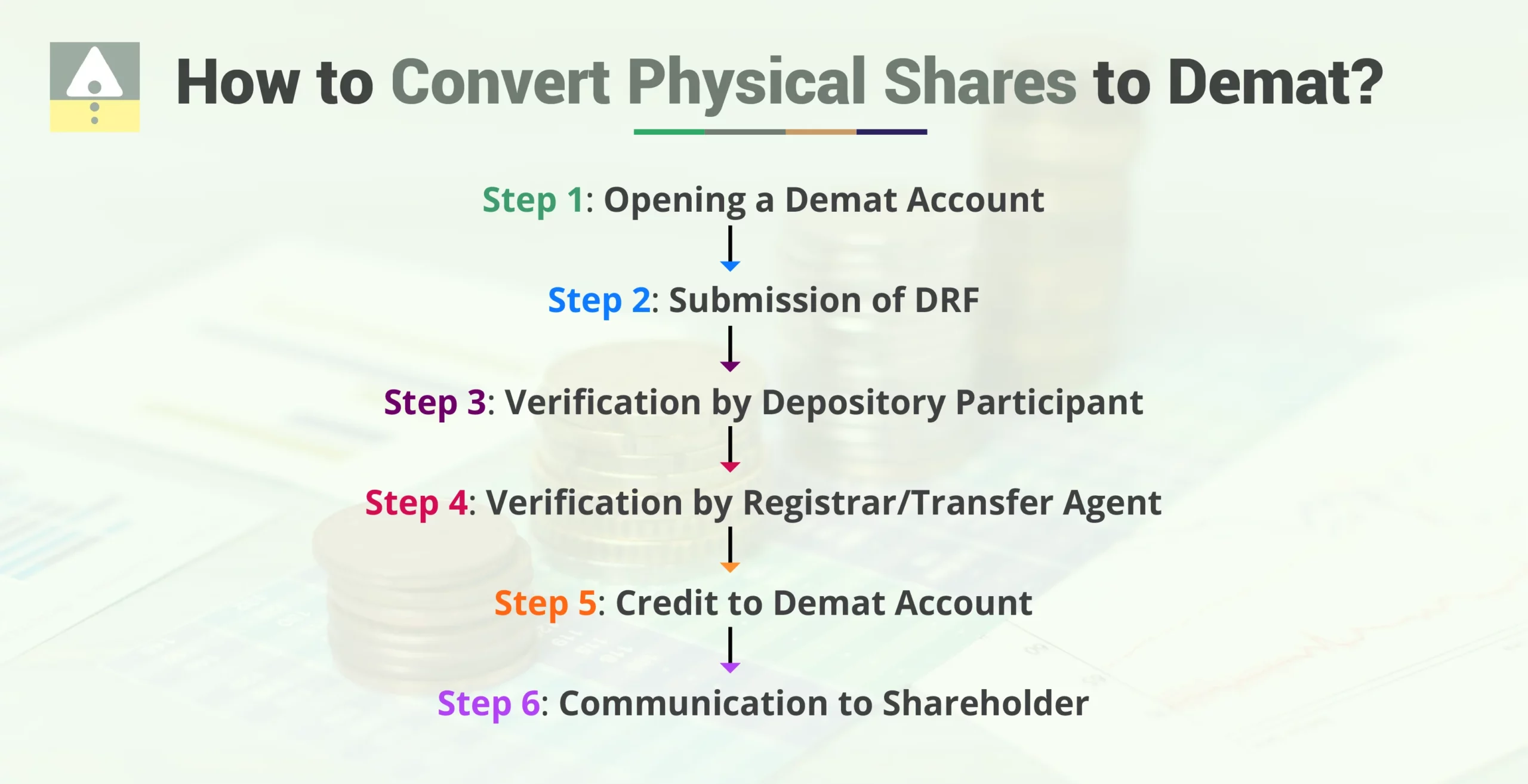
STEP – 1: Opening a Demat Account
The shareholder or user must open a demat account with a Depository Participant (DP). A DP is an intermediary between the investor and the central depository (e.g., NSDL or CDSL in India).
STEP -2: Submission of Dematerialisation Request Form (DRF)
The shareholder needs to fill out a DRF i.e., Dematerialisation Request Form, and submit it to their DP along with the physical share certificates.
The certificates must be defaced by writing “Surrendered for Dematerialisation” on them.
STEP – 3: Verification by Depository Participant
The Depository Participant will verify the details on the Dematerialisation Request Form and the physical certificates. If the documents are in order, the DP will send the DRF and the physical certificates to the company’s registrar or transfer agent.
STEP – 4: Verification by Registrar/Transfer Agent
The registrar or transfer agent will verify the details and authenticity of the physical certificates. Upon successful verification, they will confirm the Dematerialization request to the depository.
STEP – 5: Credit to Demat Account
The depository will update its records and credit the shareholder’s demat account with the corresponding number of shares.
The shareholder will receive a confirmation of the credit in their demat account.
STEP – 6: Communication to Shareholder
The DP will inform the shareholder about the successful conversion of physical shares into electronic form.
Read More: Demat Account Holding Statement
Eligibility for Converting Physical Shares to Demat
To convert physical shares into electronic form (demat), certain criteria and requirements need to be met. Here are the key points of eligibility and prerequisites:

1. Ownership of Physical Share Certificates
You must own physical share certificates that you wish to convert to demat form.
2. Opening a Demat Account
You need to have a demat account with a Depository Participant (DP). This account functions like a bank account but for securities.
3. Know Your Customer (KYC) Compliance
You must complete the KYC process, which involves submitting proof of identity, proof of address, and a recent photograph. Commonly accepted documents include:
- Identity Proof: PAN card, Aadhaar card, passport, voter ID card, or driving license.
- Address Proof: Utility bills, bank statements, or government-issued address proof.
4. Account Details with Depository Participant
Ensure that your demat account details with the DP are accurate and up-to-date. This includes providing your bank account details for linking with the demat account.
5. Submission of Physical Share Certificates
You must submit the original physical share certificates to your DP along with a duly filled Dematerialisation Request Form (DRF).
6. No Lien or Encumbrance on Shares
The physical shares should be free of any lien, encumbrance, or legal dispute. The shares must be in your name and not pledged or locked in.
7. DRF and Supporting Documents
Along with the DRF, submit any additional documents required by the DP or the company’s registrar/transfer agent. This might include a declaration or indemnity bond in case of any discrepancies.
Open free demat account in 5 minutes
Difference Between Physical Shares and Demat Shares
Physical shares and demat shares represent two different methods of holding and managing stock ownership. Here are the key differences between them:
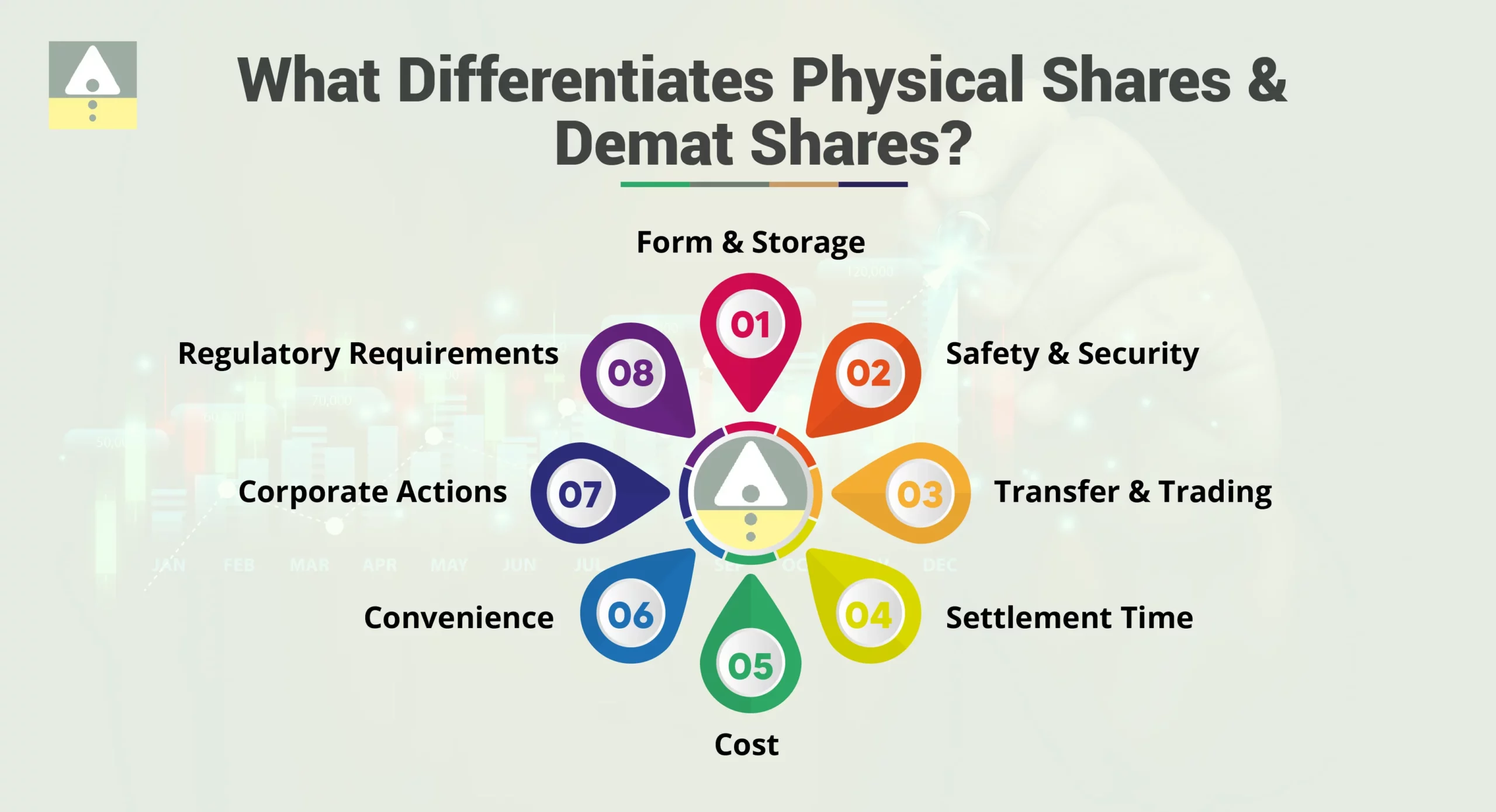
1. Form and Storage
- Physical Shares: Represented by paper certificates. Each certificate includes details such as the shareholder’s name, number of shares, and the company’s name.
- Demat Shares: Stored electronically in a demat account. No physical certificates are involved; all records are maintained digitally.
2. Safety and Security
- Physical Shares: Prone to risks such as loss, theft, damage, and forgery. Replacing lost or damaged certificates can be a lengthy and complicated process.
- Demat Shares: More secure as they are held in electronic form. They are not susceptible to physical damage or theft.
3. Transfer and Trading
- Physical Shares: Transferring ownership requires endorsing and physically handing over the share certificates. This process can be time-consuming and involves significant paperwork.
- Demat Shares: Transferring shares is done electronically, making it faster, easier, and more efficient. Transactions are processed quickly, typically within a couple of days.
4. Settlement Time
- Physical Shares: The settlement process is slower and may take weeks due to the physical transfer and verification of certificates.
- Demat Shares: Settlements are quicker, and generally completed within two working days (T+2 settlement cycle).
5. Cost
- Physical Shares: Involves costs related to printing, handling, and storing physical certificates. There may also be costs for postal services and stamp duty during transfers.
- Demat Shares: Reduces or eliminates these costs. There may be nominal fees for maintaining a Demat account, but overall transaction costs are lower.
6. Convenience
- Physical Shares: Managing and tracking investments can be cumbersome due to the need for physical handling and storage of certificates.
- Demat Shares: Offers greater convenience. Investors can manage their portfolios online, view transaction history, and access various services provided by the depository and DP.
7. Corporate Actions
- Physical Shares: Processing corporate actions like dividends, bonus issues, and rights issues can be slower and may require additional paperwork.
- Demat Shares: Corporate actions are processed automatically and directly credited to the demat account, making the process seamless and efficient.
8. Regulatory Requirements
- Physical Shares: Some jurisdictions may have regulatory restrictions on trading physical shares, and many have moved to mandate electronic holding.
- Demat Shares: Comply with modern regulatory requirements, making them the standard for trading and holding securities in many markets.
Demat shares have largely replaced physical shares due to the numerous advantages they offer in terms of safety, efficiency, and convenience. Here’s a table of how physical share and demat share differ based on different aspects:
| Aspect | Physical Share | Demat Share |
| Storage | Stored physically by the shareholder. | Stored electronically in a demat account. |
| Safety and Security | Prone to loss, theft, damage, and forgery. | Secure, no risk of physical damage or theft. |
| Transfer Process | Manual involves endorsement and physical delivery. | Electronic, quick, and efficient. |
| Settlement Time | Longer, can take weeks. | Faster, typically within two working days (T+2). |
| Cost | Higher due to printing, handling, and postage. | Lower, minimal fees for demat accounts. |
| Convenience | Less convenient, and requires physical handling. | More convenient, managed online. |
| Corporate Actions | Slower, manual processing is required. | Automatic, processed electronically |
| Regulatory Compliance | Often requires additional steps for compliance. | Generally compliant with modern regulations. |
| Risk of Fraud | Higher, susceptible to forgery. | Lower, secure electronic records. |
Risks Associated with Holding Physical Shares
Holding physical shares involves several risks due to the nature of paper certificates and the processes involved in managing them. Here are the primary risks associated with holding physical shares:
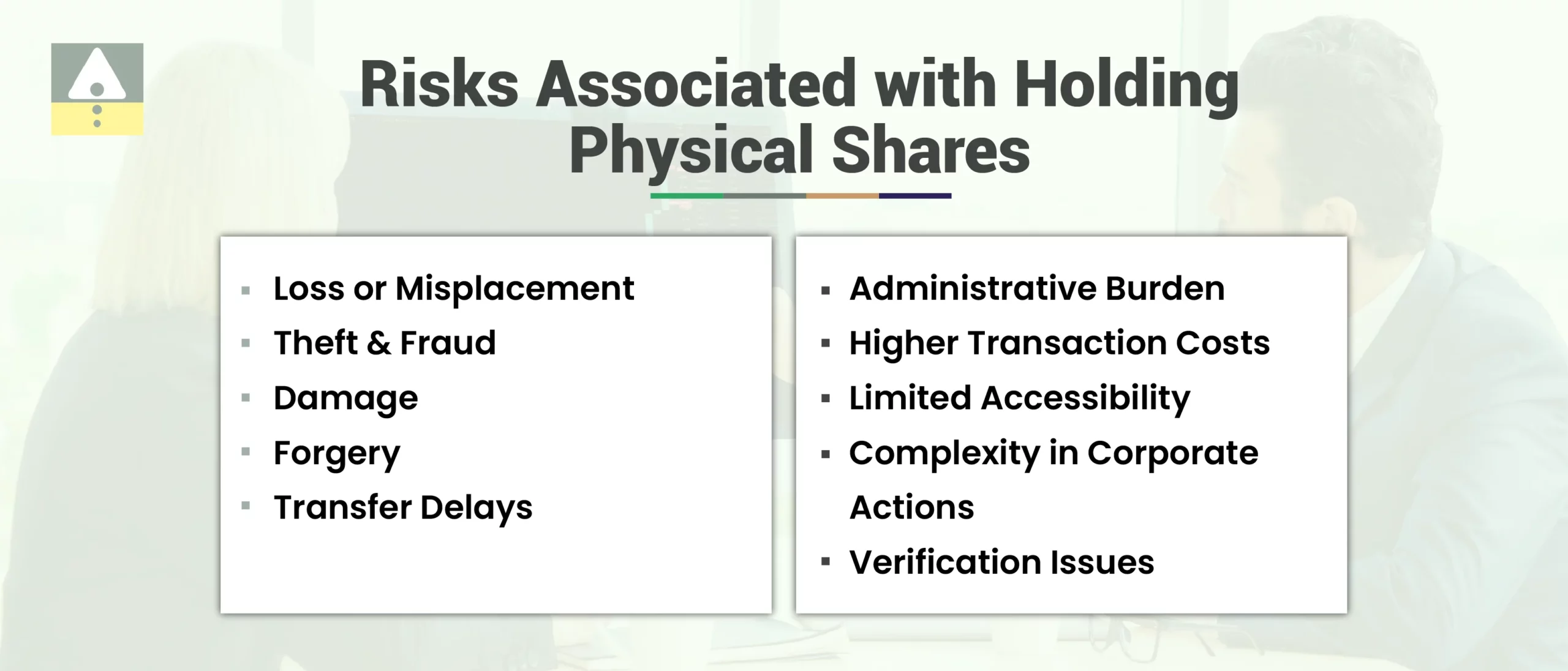
1. Loss or Misplacement
- Risk: Physical share certificates can be easily lost or misplaced.
- Impact: Recovering lost certificates involves a lengthy process, including notifying the company, issuing an indemnity bond, and potentially obtaining a duplicate certificate.
2. Theft and Fraud
- Risk: Physical certificates are susceptible to theft or fraudulent activities.
- Impact: Stolen certificates can be transferred fraudulently, leading to legal complications and potential financial loss.
3. Damage
- Risk: Physical certificates can be damaged due to environmental factors (e.g., fire, water, or general wear and tear).
- Impact: Damaged certificates may become illegible, making it difficult to prove ownership and requiring replacement.
4. Forgery
- Risk: Physical certificates can be forged or tampered with.
- Impact: Forged certificates can lead to disputes over ownership and may require legal action to resolve.
5. Transfer Delays
- Risk: Transferring physical shares involves manual processes, including endorsement and physical delivery.
- Impact: These processes are time-consuming and can lead to delays in the transfer and settlement of shares.
6. Administrative Burden
- Risk: Managing physical share certificates requires significant administrative effort.
- Impact: Tracking, storing, and handling multiple certificates can be cumbersome and prone to errors.
7. Higher Transaction Costs
- Risk: Physical share transactions incur additional costs for printing, handling, mailing, and stamp duties.
- Impact: These costs can add up, making the overall process more expensive compared to electronic transactions.
8. Limited Accessibility
- Risk: Physical certificates must be presented in person or mailed for transactions.
- Impact: This limits the ease of access and flexibility for investors, especially in remote or urgent situations.
9. Complexity in Corporate Actions
- Risk: Handling corporate actions (e.g., dividends, bonus issues, rights issues) requires manual intervention.
- Impact: The process is slower and more complex, potentially leading to delays in receiving benefits.
10. Verification Issues
- Risk: Verifying the authenticity of physical certificates can be challenging.
- Impact: Discrepancies or disputes in verification can delay transactions and cause legal complications.
Conclusion
Converting physical shares to demat accounts is a prudent decision in today’s digital age, which offers enhanced security, convenience, and efficiency in trading and investing. Investors can experience a seamless transition to the digital world of securities exchange once they choose to convert physical shares into Demat Accounts.
If you are also keen on transferring your physical shares into your demat account, wait no further. Jainam Broking Limited is here to guide you on how it can be done.
Open a Demat Account with Jainam Broking Limited Now!
Frequently Asked Questions
What are the costs associated with maintaining a Demat account?
The costs associated with maintaining a Demat account include account opening fees, annual maintenance charges, transaction fees, and other miscellaneous charges. Investors should inquire about these costs before opening a Demat account to avoid any surprises.
Open Free Demat Account!
Join our 3 Cr+ happy customers
For first 30 days*

Start Your Journey with Jainam
Open your free Demat account in minutes or explore partnership opportunities with Jainam.
Explore our feature-rich web trading platform
Get the link to download the App