



Introduction
Bookkeeping, a vital aspect of financial accounting, involves more than just recording transactions. Every transaction rules of accounting requires two entries: debit and credit. The key challenge involves determining which accounts to credit and which to debit. The dual-entry accounting system addresses this challenge by ensuring accurate recording of financial transactions.
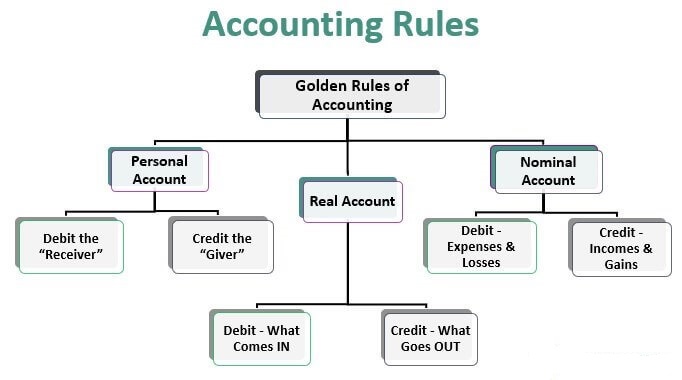
The three golden rules of accounting serve as the foundation for financial accounting, guiding the recording of financial transactions systematically. These rules simplify complex bookkeeping processes into easily understandable concepts, making them accessible and practical for businesses of all sizes.
Types of Accounts in Accounting
Before diving into the golden rules, it’s essential to understand the different types of accounts. The golden rules vary depending on the type of account involved in a transaction.
1. Nominal Account
A nominal account is a general ledger account that records all income, expenses, profits, and losses for a business within a specific fiscal year. At the end of the year, the balances are reset to zero, allowing the process to begin anew. Nominal accounts play a critical role in understanding a business’s financial performance over a particular period. For example, interest payments fall under nominal accounts.
2. Real Account
A real account is a ledger account that records all assets and liabilities, including both tangible and intangible assets. Tangible assets might include furniture, land, buildings, and machinery, while intangible assets encompass goodwill, copyrights, and patents. Real accounts differ from nominal accounts because they remain open at the end of the fiscal year. Businesses carry them forward to the next year, and they appear on the balance sheet. An example of a real account is a furniture account.
3. Personal Account
A personal account pertains to individuals or entities, whether natural persons (humans) or artificial persons (corporations, firms, associations). In transactions involving personal accounts, the entity receiving funds is the debtor, while the entity giving funds is the creditor. For example, if Company A receives a loan from another firm, Company A is the receiver, and the other firm becomes the giver.
You may also want to know Tax on Gifts in India
Golden Rules of Accounting
The 3 golden rules of accounting ensure that financial transactions are recorded accurately and consistently. Let’s explore each rule in detail:
1. Debit What Comes In, Credit What Goes Out
This is one of the golden rules of accounting. This rule applies to real accounts. When a business acquires a tangible or intangible asset, it debits the asset account to represent what enters the business. Conversely, when the business gives away or sells an asset, it credits the asset account to reflect what exits. For example, when a company purchases a machine, it debits the machine account (a real account).
2. Debit the Receiver, Credit the Giver
This rule governs personal accounts. The business credits the giver when a person or entity provides something to it. Conversely, it debits the receiver when the business gives something to another person or entity. For example, if a company receives a loan from a bank, it credits the bank (the giver) and debits itself (the receiver).
3. Debit All Expenses and Losses, Credit All Income
This rule applies to nominal accounts. Expenses are debited because they reduce the capital or profits of the business. Income, on the other hand, is credited because it increases the business’s capital or profits. For example, if a company incurs a utility expense, the utility expense account (a nominal account) is debited.
Benefits of Following the Golden Rules of Accounting
1. Ensures Accurate Financial Records:
Adhering to the golden rules helps maintain accurate and consistent financial records, reducing errors and discrepancies.
2. Facilitates Financial Analysis:
Proper accounting practices allow businesses to analyze their financial health effectively, aiding in better decision-making.
3. Compliance with Legal Requirements:
Following these rules ensures compliance with legal and regulatory standards, which is essential for audits and avoiding penalties.
4. Simplifies the Audit Process:
Clear and accurate records make the auditing process smoother and faster, ensuring transparency and trustworthiness.
5. Aids in Financial Planning:
Accurate accounting helps businesses plan their budgets, allocate resources, and forecast future finances effectively.
6. Prevents Fraud:
Consistent application of accounting rules can help detect discrepancies, minimizing the risk of fraudulent activities.
7. Builds Trust with Stakeholders:
Proper accounting builds credibility, fostering trust among investors, creditors, and other stakeholders.
8. Improves Internal Management:
Clear financial records assist in managing daily business operations and monitoring cash flow effectively.
9. Ensures Consistency Across Financial Periods:
By following the same rules, companies maintain consistency across different financial periods, making comparisons easier.
10. Assists in Tax Preparation:
Accurate accounting records simplify tax calculation and filing, reducing the risk of errors and penalties.
You may also want to know Value Added Tax (VAT)
Who Must Follow the Golden Rules of Accounting?
The golden rules of accounting are fundamental principles that must be followed by all types of businesses, whether small enterprises, large corporations, or non-profit organizations. They are also essential for individuals who manage their personal finances or investments in a structured manner. Additionally, accountants, bookkeepers, and financial managers are required to apply these rules to maintain the accuracy and reliability of financial records.
Essentially, anyone who deals with financial transactions, from students learning accounting to professional accountants, must adhere to these rules to ensure consistent and accurate record-keeping.
According to Rule 6F of the Income Tax Act, the following professions are mandated to maintain financial transaction records following the golden rules of accounting if their receipts exceed Rs. 1.5 lakhs in the previous three years:
- Legal
- Technical Consultation
- Architectural
- Engineering
- Accountancy
- Authorized Representation
- Film Artists
- Medical
- Interior Decoration
- Company Secretary
If a professional’s receipts do not exceed Rs. 1.5 lakhs, they are not required to maintain comprehensive books of accounts. However, they must still maintain records that allow an Accounts Officer to assess their taxable income.
Fundamental Accounting Principles
1. Consistency:
Financial practices and reporting methods should be consistent across all accounting periods to ensure comparability.
2. Relevance:
Accounting information must be relevant to the decision-making process of stakeholders, providing them with useful insights.
3. Reliability:
Financial data should be reliable, accurate, and verifiable, ensuring stakeholders can trust the information presented.
4. Accrual Principle:
Revenues and expenses should be recorded when they are earned or incurred, not when the cash is received or paid.
5. Going Concern Principle:
It is assumed that the business will continue to operate indefinitely unless there is evidence to the contrary.
6. Matching Principle:
Expenses must be matched with the revenues they help generate, ensuring accurate profit calculation for a period.
7. Prudence (Conservatism):
Accountants should record expenses and liabilities as soon as they are certain, but revenues only when they are assured. This avoids overstating financial positions.
These principles provide a standardized approach to accounting, ensuring that financial statements are accurate, reliable, and consistent.
Conclusion
Understanding and applying the golden rules of accounting is crucial for maintaining accurate financial records and ensuring the financial health of a business. These rules provide a solid foundation for systematic bookkeeping, compliance with regulatory requirements, and strategic decision-making. By following these principles, businesses can achieve greater transparency, reliability, and efficiency in their financial operations.
Frequently Asked Questions
What are the three golden rules of accounting?
The three golden rules of accounting are Debit what comes in, credit what goes out (Real Accounts). Debit the receiver, credit the giver (Personal Accounts). Debit all expenses, credit all income (Nominal Accounts).
Why are the golden rules of accounting important?
The golden rules of accounting are important because they ensure that financial transactions are recorded accurately and consistently, providing a reliable basis for financial reporting and decision-making.
What types of accounts do the golden rules of accounting apply to?
The golden rules of accounting apply to three types of accounts: real accounts, personal accounts, and nominal accounts.
Can you provide an example of applying the golden rules of accounting?
Sure! If a company purchases office furniture (a tangible asset), it would debit the furniture account (real account) because the furniture is coming into the business.
What is the going concern principle in accounting?
The going concern principle assumes that a business will continue to operate indefinitely unless there is evidence suggesting otherwise. This principle allows for the proper management of assets, liabilities, and depreciation.
Open Free Demat Account
Related Terms
- 80EE and 80EEA
- Advance Tax Payment
- Advantages and Disadvantages of GST
- Agricultural Income
- Alternative Minimum Tax
- Banglarbhumi
- CGST
- Children Education Allowance (CEA)
- Company Registration Online
- Conveyance Allowance
- Corporate Tax
- Cost Accounting
- Dearness Allowance
- Depreciation Under Income Tax Act
- Difference Between GST and VAT
- Direct and Indirect Tax
- Dividend Distribution Tax (DDT)
- E-filing Income Tax
- E-Invoicing Under GST
- E-Way Bill Portal
- Education Cess
- Excise Duty
- Financial Year and Assessment Year
- Form 10E
- Form 10F
- Form 12B
- Form 15CA and 15CB
- Form 15H
- Form 16
- Form 16 and Form 16A
- Form 16B
- Form 16C
- Form 24Q
- Form 26AS
- Form 26Q
- Form 26QB
- Form 26QC
- Form 27Q
- Form 61A
- Goods and Services Tax (GST)
- Government GST Portal
- Gratuity Rules
- Gross Salary
- GST Amnesty Scheme
- GST Calendar 2024
- GST Composition Scheme
- GST Filing
- GST HSN Code
- GST Invoice
- GST on Bikes
- GST on Cars
- GST on Cement
- GST on Electronics
- GST on Food and Restaurants
- GST on Freight Charges
- GST on Gold
- GST on Mobile Phones and Accessories
- GST on Real Estate
- GST on Transport
- GST Rates
- GST Registration
- GST Return Late Fees and Interest
- GST Seva Kendra
- GST State Code List and Jurisdiction
- GSTIN
- GSTN – Goods and Service Tax Network
- GSTR 1
- GSTR 2
- GSTR 2A
- GSTR 2B
- GSTR 3B
- GSTR 4
- GSTR 9A
- GSTR 9C
- House Rent Allowance (HRA)
- How to Generate E-Way Bill?
- IGST
- Income Certificate Online
- Income Tax
- Income Tax Act
- Income Tax for NRIs
- Income Tax for Senior Citizens
- Income Tax Helpline Number
- Income Tax Login
- Income Tax Online Payment
- Income Tax Refund
- Income Tax Return
- Income Tax Returns Filing Due Date
- Income Tax Slab
- Input Tax Credit Under GST
- Leave Encashment Tax
- Leave Travel Allowance (LTA)
- Medical Allowance
- MoA Format
- MSME Contribution
- MSME Registration in India
- MSME Schemes in India
- Payment of Gratuity Act, 1972
- Professional Tax
- Property Tax
- Repo Rate
- Residential Status Under Income Tax Act
- Reverse Charge Under GST
- Section 10
- Section 10(10D)
- Section 115 BAC
- Section 115BAB
- Section 12A
- Section 143(1)
- Section 148
- Section 154
- Section 16
- Section 17(5)
- Section 185
- Section 186
- Section 192A
- Section 193
- Section 194
- Section 194A
- Section 194B
- Section 194C
- Section 194D
- Section 194H
- Section 194I
- Section 194IA
- Section 194IB
- Section 194IC
- Section 194J
- Section 194K
- Section 194N
- Section 194Q
- Section 195
- Section 206AA
- Section 234F
- Section 24
- Section 40A(2)
- Section 40A(3) & Section 40A(3A)
- Section 43B
- Section 44AB
- Section 44AD
- Section 44ADA
- Section 80C
- Section 80CCC
- Section 80CCD (1) and 80CCD (2)
- Section 80CCD(1B)
- Section 80CCG
- Section 80D
- Section 80DD
- Section 80DDB
- Section 80E
- Section 80EE
- Section 80EEA
- Section 80EEB
- Section 80G and 80GGA
- Section 80GG
- Section 80TTA
- Section 80TTB
- Section 80U
- Section 87A
- Section 89A
- Section 94A
- Self Assessment Tax
- SGST
- Special Allowance
- Standard Deduction on Salary
- Tax Collected at Source (TCS)
- Tax in India
- Tax on Gifts in India
- Taxability of Perquisites
- TDS – Tax Deducted at Source
- TDS on Fixed Deposit (FD)
- TDS on Salary
- TDS Payment Due Date
- TDS Rates in India
- TDS Refund Status
- TDS Return
- TDS Traces
- TIN and TAN
- Top MSME Benefits
- Types of GST
- Value Added Tax (VAT)
- VAT and CENVAT
- VAT Registration
- VAT Return e-Filing
- What is a Debit Note, Credit Note and Revised Invoice?
- What is E-Way Bill?
- What is Form 16A?
- What is MSME
- What is TAN?
- What is the 50/30/20 Rule of Budgeting?
- Which ITR Should You File – Types of ITR Forms
Explore our feature-rich web trading platform
Get the link to download the App